



Latest Updates
Launch of the International Science Program on Fusion Burning Plasma and Release of the BEST Research Plan
Date:2025-11-28 Views:201
On November 24, 2025, the launch ceremony for the International Science Program on Fusion Burning Plasma and the release of the BEST Research Plan were held at the BEST facility hall in Hefei Future Science Town.
At the event, the CAS International Science Program on Fusion Burning Plasma was officially launched and the BEST Research Plan was released to the international fusion community. Fusion scientists from over 10 countries, including France, the UK, Germany, Italy, Switzerland, Spain, Austria, and Belgium, jointly signed the Hefei Fusion Declaration. The fusion scientists noted that decades of international collaboration and development in fusion research have led to a series of major breakthroughs, yet significant challenges remain. Addressing these challenges requires pooling the wisdom and strength of scientists worldwide to engage in more practical, closer, and open international exchanges and cooperation. They advocated for the spirit of open access and win-win cooperation, encouraging researchers in the field of fusion to conduct collaborative research in Hefei. Together, they aim to create a bright future for fusion energy and realize humanity's ultimate energy dream.
With the rapid progress of international projects such as the ITER and burning plasma experimental facilities like BEST, fusion experimental research is entering a new phase of burning plasma physics. The Institute of Plasma Physics (ASIPP) initiated the International Science Program on Fusion Burning Plasma, while Chinese and EU fusion research teams jointly released the BEST Research Plan globally. This initiative aims to further integrate international collaborative resources in the field of fusion, pool the intellectual strength of global fusion scientists, and conduct cooperative research on cutting-edge fusion physics issues. This will be achieved by establishing open research funds, organizing international academic conferences, building joint experimental platforms, attracting foreign talents to collaborate in China, and developing an internationalized team of experts.
With half a century of innovation and accumulated expertise, Hefei Science Island has become a key international hub for fusion research, supported by national large-scale scientific facilities in the field such as the fully superconducting tokamak EAST, the EAST auxiliary heating systems, and the Comprehensive Research Facility for Fusion Technology (CRAFT). Centered on the development and operation of large-scale scientific facilities, the ASIPP has established stable collaborative partnerships with over 120 research institutions across more than 50 countries. Its tokamak facilities have become a benchmark for open-access large-scale scientific facilities, and have been included in the open-access directories or recognized as representative cases by the Group of Senior Officials on Global Research Infrastructures (GSO), OECD, and BRICS. The Sino-French Fusion Energy Center, Sino-Russian Superconducting Proton Center, Sino-U.S. International Tokamak Cooperation Research Center, and International Joint Center for Fusion Energy have been successively put into operation, delivering significant innovative achievements with international impact. Key fusion engineering technologies and core components have been applied in multiple large-scale scientific facilities worldwide. In response to the Belt and Road Initiative, support has been extended for developing relevant disciplines and experimental facilities in emerging nuclear fusion countries across Southeast Asia, West Asia, South America, and North Africa. The innovative EAST "three-shift system" joint physics experiments have been implemented, with half of the annual experimental proposals originating from partner institutions. Additionally, six international collaboration experts have been awarded the Chinese Government Friendship Award and the China International Science and Technology Cooperation Award. In addition, the ASIPP has been deeply involved in the ITER project for two decades. As a key member of the Chinese ITER team, the ASIPP has mastered key fusion engineering technologies through independent R&D efforts. Its delivery progress and product quality rank among the top of the seven ITER parties, setting multiple records. A series of "Chinese designs" and "Chinese manufacturing" have been applied to the ITER project, earning high praise from the ITER Organization and making significant contributions to the ITER project.
Leveraging the development and operation of superconducting tokamak facility clusters, the ASIPP is giving full play to the systematic and structured advantages of its large-scale scientific teams. It is accelerating the building of an innovation hub for fusion energy, contributing to the sci-tech self-reliance and self-strengthening at higher levels. Moreover, it is contributing its expertise and capabilities to the building of a shared future for humanity. The ASIPP will continue to advance the International Science Program on Fusion Burning Plasma and facilitate open research on fusion-related large-scale scientific facilities. It aims to establish an open innovation ecosystem and a global sci-tech collaboration network with international competitiveness and influence. By collaborating with scientists in fusion research both domestically and internationally, the ASIPP seeks to further enhance China's voice and influence in fusion energy science and technology, accelerate the transition of fusion research from scientific experiments to engineering applications, and make greater contributions to global fusion research efforts.
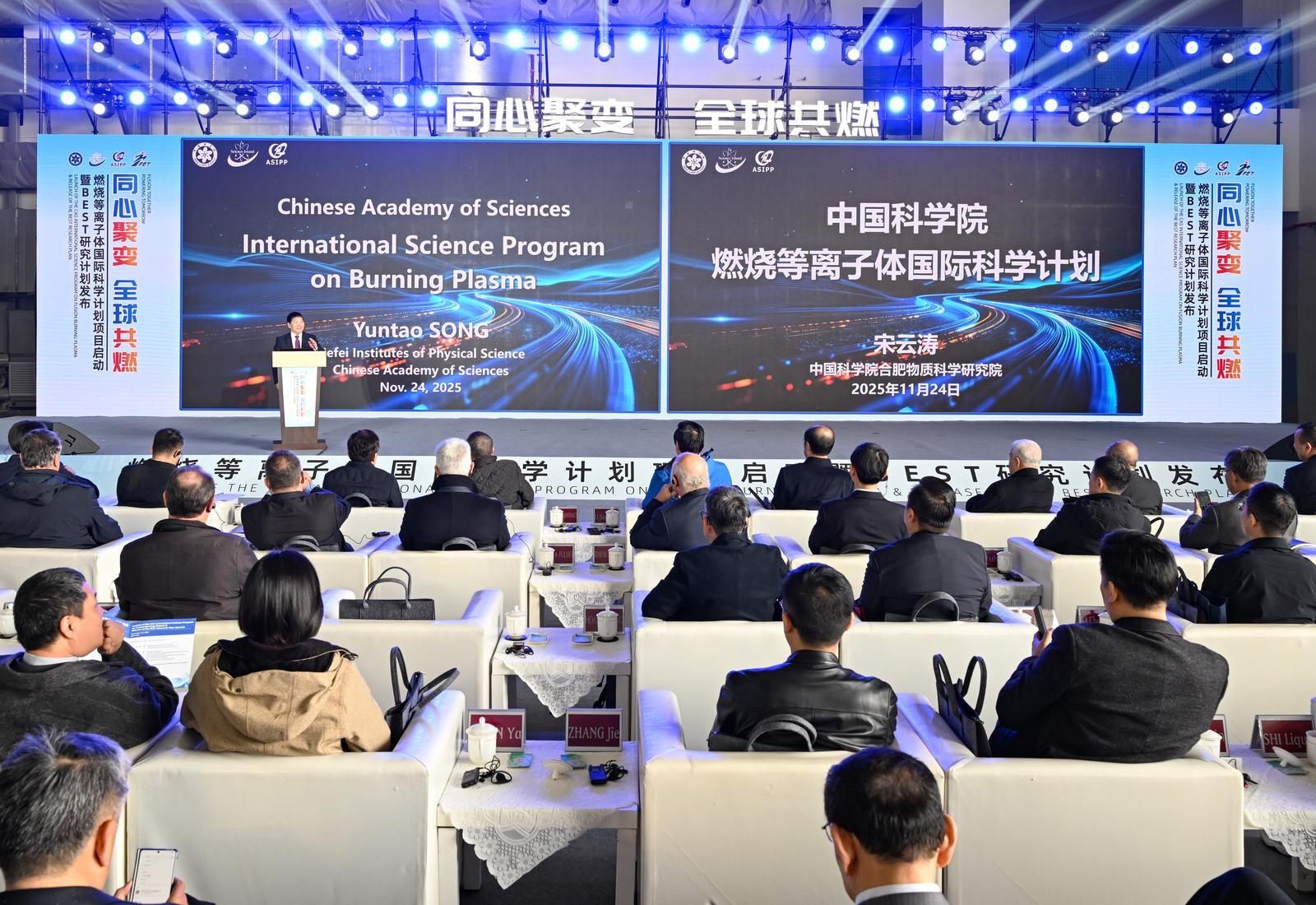

On November 24, 2025, the launch ceremony for the International Science Program on Fusion Burning Plasma and the release of the BEST Research Plan were held at the BEST facility hall in Hefei Future Science Town.
At the event, the CAS International Science Program on Fusion Burning Plasma was officially launched and the BEST Research Plan was released to the international fusion community. Fusion scientists from over 10 countries, including France, the UK, Germany, Italy, Switzerland, Spain, Austria, and Belgium, jointly signed the Hefei Fusion Declaration. The fusion scientists noted that decades of international collaboration and development in fusion research have led to a series of major breakthroughs, yet significant challenges remain. Addressing these challenges requires pooling the wisdom and strength of scientists worldwide to engage in more practical, closer, and open international exchanges and cooperation. They advocated for the spirit of open access and win-win cooperation, encouraging researchers in the field of fusion to conduct collaborative research in Hefei. Together, they aim to create a bright future for fusion energy and realize humanity's ultimate energy dream.
With the rapid progress of international projects such as the ITER and burning plasma experimental facilities like BEST, fusion experimental research is entering a new phase of burning plasma physics. The Institute of Plasma Physics (ASIPP) initiated the International Science Program on Fusion Burning Plasma, while Chinese and EU fusion research teams jointly released the BEST Research Plan globally. This initiative aims to further integrate international collaborative resources in the field of fusion, pool the intellectual strength of global fusion scientists, and conduct cooperative research on cutting-edge fusion physics issues. This will be achieved by establishing open research funds, organizing international academic conferences, building joint experimental platforms, attracting foreign talents to collaborate in China, and developing an internationalized team of experts.
With half a century of innovation and accumulated expertise, Hefei Science Island has become a key international hub for fusion research, supported by national large-scale scientific facilities in the field such as the fully superconducting tokamak EAST, the EAST auxiliary heating systems, and the Comprehensive Research Facility for Fusion Technology (CRAFT). Centered on the development and operation of large-scale scientific facilities, the ASIPP has established stable collaborative partnerships with over 120 research institutions across more than 50 countries. Its tokamak facilities have become a benchmark for open-access large-scale scientific facilities, and have been included in the open-access directories or recognized as representative cases by the Group of Senior Officials on Global Research Infrastructures (GSO), OECD, and BRICS. The Sino-French Fusion Energy Center, Sino-Russian Superconducting Proton Center, Sino-U.S. International Tokamak Cooperation Research Center, and International Joint Center for Fusion Energy have been successively put into operation, delivering significant innovative achievements with international impact. Key fusion engineering technologies and core components have been applied in multiple large-scale scientific facilities worldwide. In response to the Belt and Road Initiative, support has been extended for developing relevant disciplines and experimental facilities in emerging nuclear fusion countries across Southeast Asia, West Asia, South America, and North Africa. The innovative EAST "three-shift system" joint physics experiments have been implemented, with half of the annual experimental proposals originating from partner institutions. Additionally, six international collaboration experts have been awarded the Chinese Government Friendship Award and the China International Science and Technology Cooperation Award. In addition, the ASIPP has been deeply involved in the ITER project for two decades. As a key member of the Chinese ITER team, the ASIPP has mastered key fusion engineering technologies through independent R&D efforts. Its delivery progress and product quality rank among the top of the seven ITER parties, setting multiple records. A series of "Chinese designs" and "Chinese manufacturing" have been applied to the ITER project, earning high praise from the ITER Organization and making significant contributions to the ITER project.
Leveraging the development and operation of superconducting tokamak facility clusters, the ASIPP is giving full play to the systematic and structured advantages of its large-scale scientific teams. It is accelerating the building of an innovation hub for fusion energy, contributing to the sci-tech self-reliance and self-strengthening at higher levels. Moreover, it is contributing its expertise and capabilities to the building of a shared future for humanity. The ASIPP will continue to advance the International Science Program on Fusion Burning Plasma and facilitate open research on fusion-related large-scale scientific facilities. It aims to establish an open innovation ecosystem and a global sci-tech collaboration network with international competitiveness and influence. By collaborating with scientists in fusion research both domestically and internationally, the ASIPP seeks to further enhance China's voice and influence in fusion energy science and technology, accelerate the transition of fusion research from scientific experiments to engineering applications, and make greater contributions to global fusion research efforts.