


Latest Updates
The Cryostat Base, the First Key Component of the BEST Facility, Has Been Successfully Installed
Date:2025-11-17 Views:177
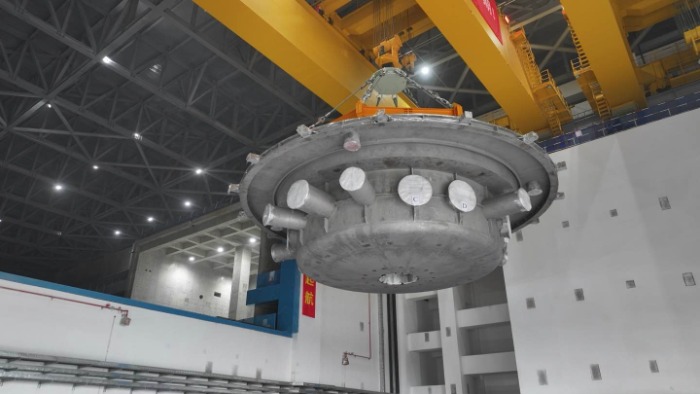
Recently, a critical breakthrough was achieved in the BEST project, a compact fusion energy experimental facility. The key component—the cryostat base—was successfully developed and delivered, then precisely positioned and installed in the main hall of the BEST facility. As the first key component to enter the main hall, its installation marks the project's entry into a new phase of main structure construction, accelerating both component development and engineering assembly.
The cryostat base is the first major vacuum component of the BEST facility, featuring complex design conditions and hundreds of interfaces. With a diameter of approximately 18 m, a height of about 5 m, and a total weight of over 400 tons, it is the heaviest component of the BEST machine system and the largest vacuum component in China's fusion sector. This component supports tens of thousands of tons of weight for the BEST facility while providing thermal insulation, and its installation accuracy directly impacts the stability and safety of the entire project. Through close collaboration, the project team led by the Institute of Plasma Physics at the Hefei Institutes of Physical Science successfully overcame key challenges such as high-precision forming and welding, millimeter-level deformation control, and high-vacuum sealing, ultimately achieving the successful development of the cryostat base.
The lifting of the cryostat base demanded extremely high precision, with surface leveling deviations required to be within 15 millimeters and positioning deviations not exceeding ±2 millimeters. The working space was extremely confined, with a minimal clearance of less than 100 millimeters between the outer edge of the base and the shielding wall of the tokamak pit. Facing these challenges, the project team worked tirelessly to overcome difficulties and ensure project progress. The team independently developed a specialized lifting system, utilizing components such as spreader beams, lifting beams, lifting adapters, and turnbuckles to finely adjust the hoisting levelness. Meanwhile, multiple laser trackers were employed to monitor reference points in real time and dynamically adjust the lifting posture, ultimately achieving millimeter-level precision in the installation of the cryostat base.
The manufacturing, delivery, and installation of the cryostat base have laid a solid foundation for the subsequent installation and commissioning of core components of the BEST facility. Building on the collaborative spirit of the all-superconducting tokamak major science initiative, the BEST team is now fully dedicated to advancing the installation of components, ensuring the high-quality completion of the BEST project according to schedule.
Recently, a critical breakthrough was achieved in the BEST project, a compact fusion energy experimental facility. The key component—the cryostat base—was successfully developed and delivered, then precisely positioned and installed in the main hall of the BEST facility. As the first key component to enter the main hall, its installation marks the project's entry into a new phase of main structure construction, accelerating both component development and engineering assembly.
The cryostat base is the first major vacuum component of the BEST facility, featuring complex design conditions and hundreds of interfaces. With a diameter of approximately 18 m, a height of about 5 m, and a total weight of over 400 tons, it is the heaviest component of the BEST machine system and the largest vacuum component in China's fusion sector. This component supports tens of thousands of tons of weight for the BEST facility while providing thermal insulation, and its installation accuracy directly impacts the stability and safety of the entire project. Through close collaboration, the project team led by the Institute of Plasma Physics at the Hefei Institutes of Physical Science successfully overcame key challenges such as high-precision forming and welding, millimeter-level deformation control, and high-vacuum sealing, ultimately achieving the successful development of the cryostat base.
The lifting of the cryostat base demanded extremely high precision, with surface leveling deviations required to be within 15 millimeters and positioning deviations not exceeding ±2 millimeters. The working space was extremely confined, with a minimal clearance of less than 100 millimeters between the outer edge of the base and the shielding wall of the tokamak pit. Facing these challenges, the project team worked tirelessly to overcome difficulties and ensure project progress. The team independently developed a specialized lifting system, utilizing components such as spreader beams, lifting beams, lifting adapters, and turnbuckles to finely adjust the hoisting levelness. Meanwhile, multiple laser trackers were employed to monitor reference points in real time and dynamically adjust the lifting posture, ultimately achieving millimeter-level precision in the installation of the cryostat base.
The manufacturing, delivery, and installation of the cryostat base have laid a solid foundation for the subsequent installation and commissioning of core components of the BEST facility. Building on the collaborative spirit of the all-superconducting tokamak major science initiative, the BEST team is now fully dedicated to advancing the installation of components, ensuring the high-quality completion of the BEST project according to schedule.